How to Authenticate Chanel Bag Hardware Properly
A Chanel bag can look convincing from across the room. The hardware is where the closer conversation begins. To authenticate Chanel bag hardware properly, assess it as part of the complete bag, not as a single pass-or-fail detail. Weight, finish, engraving, construction, and era all matter - and the strongest conclusion comes from how those details work together.
For a pre-owned purchase, hardware also tells a condition story. Light surface scratches may be expected on a well-loved Classic Flap, while peeling plating, loose components, or unusually bright replacement pieces deserve a more careful review. Knowing what to examine helps you shop with confidence while appreciating the character of a pre-loved icon.
Start With Weight, Feel, and Overall Finish
Authentic Chanel hardware is typically substantial for its size. The turn-lock, chain links, grommets, and zipper pull should feel deliberate and well-made rather than light, hollow, or sharp around the edges. A genuine bag is not always heavy, especially in smaller styles or newer seasonal designs, but its metal components should not feel flimsy.
Look at the finish under natural, indirect light. Chanel has produced hardware in a range of tones, including light gold, antique gold, champagne gold, silver-tone, ruthenium, and blackened metal. The correct color depends on the collection and production period. For that reason, a gold tone that appears muted rather than intensely yellow is not automatically a concern.
What should raise questions is an uneven coating that has no relationship to age or use. Bubbling, obvious discoloration, flaking, rough casting, or a plastic-like shine can signal poor-quality hardware. Honest wear usually appears on high-contact areas, such as the edges of a turn-lock, the underside of a chain, or a zipper pull.
Examine the CC Turn-Lock Closely
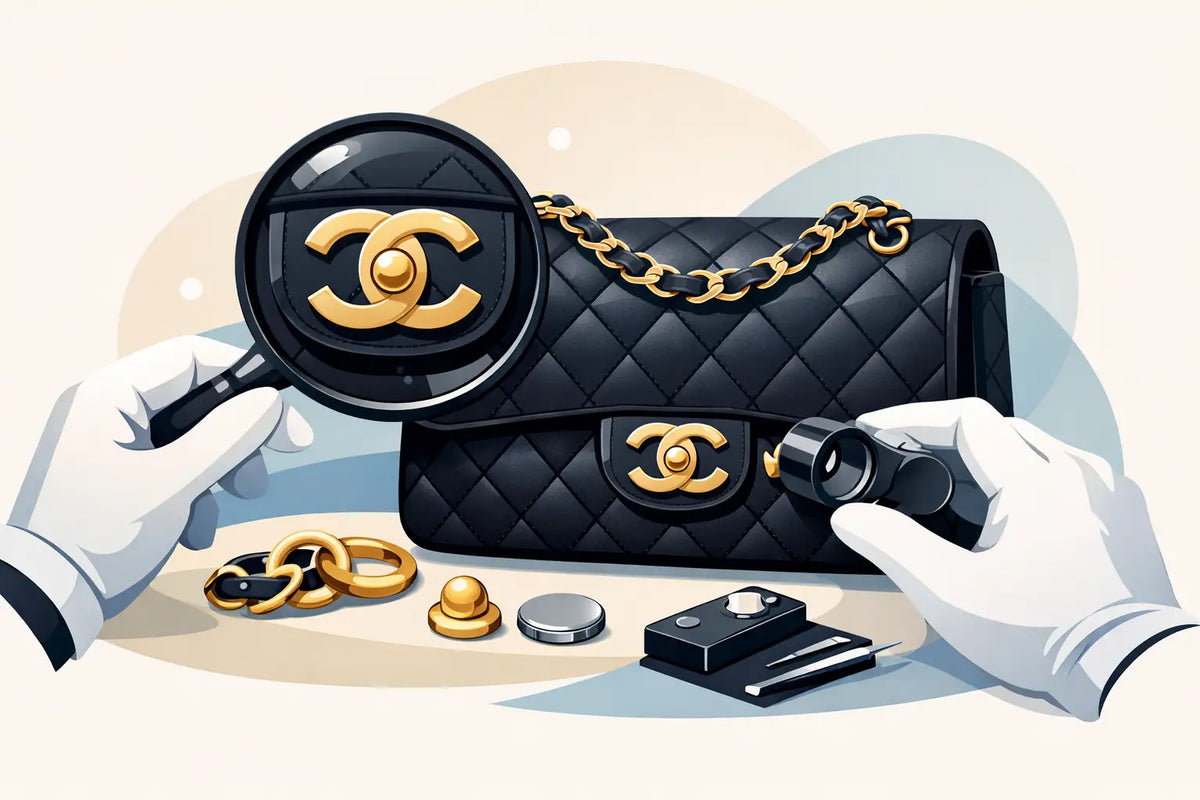
The interlocking CC turn-lock is one of Chanel's most recognizable signatures and one of the most frequently copied. On many authentic Classic Flap bags, the right C overlaps the left C at the top, while the left C overlaps the right C at the bottom. This construction is a useful reference point, but it should never be your only authentication test. Chanel has created many styles, closures, and exceptions over decades of production.
A quality turn-lock should sit cleanly against the flap and rotate with controlled movement. It should not wobble, catch, or leave a wide, irregular gap once closed. Inspect the shape of each C: the curves should be balanced, the spacing should look intentional, and the edges should be smooth. Counterfeit locks often appear too thick, too narrow, overly rounded, or poorly aligned.
Also inspect the back plate inside the bag. The screws should be neatly installed and consistent in color and scale with the surrounding hardware. On many authentic examples, flathead screws are expected rather than Phillips-head screws, but production details can vary by era and style. A single screw type cannot authenticate or disqualify a bag on its own.
Engravings Should Be Clean, Not Crowded
Depending on the model and age, hardware may carry CHANEL, PARIS, or CHANEL PARIS engravings. Authentic engraving is generally crisp, evenly spaced, and proportionate to the component. Letters should not look swollen, shallow, jagged, or compressed into a space that is too small.
Be cautious with the idea that every genuine Chanel piece must have identical markings. A vintage bag, a contemporary seasonal style, and a limited-edition design can all present hardware differently. The goal is to confirm that the engraving aligns with the bag's specific model, period, and known construction.
Check the Chain Link by Link
On quilted Chanel shoulder bags, the chain strap deserves the same scrutiny as the closure. Chain links should feel smooth, substantial, and consistently finished. Their shape and spacing should remain even along the strap, without rough seams, thin metal, or irregular openings.
For leather-woven chains, the leather should be threaded with care. It should not be excessively loose, twisted in an unnatural way, or visibly glued inside the links. Some looseness can occur with age, especially on vintage pieces, so condition should be separated from authenticity. A decades-old chain may show softened leather or minor finish loss while still being entirely genuine.
Pay attention to where the chain meets the bag. Grommets should sit securely in the leather, with clean edges and appropriate reinforcement. Hardware that pulls away from the bag, spins freely, or reveals messy glue may indicate a repair, damage, or a larger concern. A professional repair is not necessarily a reason to walk away, but it should be disclosed and reflected in the price.
Use Plating History Carefully
Collectors often associate older Chanel hardware with 24-karat gold plating. While many vintage Chanel bags are known for richly plated gold-tone hardware, this detail is frequently oversimplified online. Chanel's hardware materials and finishes have changed over time, and not every older gold-tone piece should be expected to look identical.
Rather than relying on a broad claim about plating, compare the hardware to reputable references for the exact bag. Consider the style, approximate age, leather type, and collection details. A high-quality vintage finish may develop a softer patina, while a modern finish may appear cooler or less saturated. Neither characteristic, by itself, proves authenticity.
The same principle applies to tarnishing. Some metal finishes can darken or show marks with wear, storage conditions, or exposure to moisture. A perfectly pristine chain on a heavily worn vintage bag may be more suspicious than gentle, consistent age across the piece.
Look Beyond the Turn-Lock
A careful review includes the smaller details that counterfeiters may overlook. Examine zipper pulls, zipper tracks, snap closures, feet, strap clasps, and any branded charms. They should feel properly finished and visually consistent with the primary hardware.
Zipper hardware can differ between models and production years, so avoid relying on one zipper brand or pull shape as a universal rule. Instead, look for quality construction, clean attachment points, and an appropriate match to the bag's era. A zipper that sticks may simply need professional cleaning or servicing, but a poorly attached pull or visibly cheap metal deserves closer inspection.
On bags with feet, make sure they are evenly placed and firmly secured. On vanity cases, WOCs, and seasonal designs, compare clasps and logo plaques with authenticated examples of the same style. Chanel's design language is precise, even when the bag itself is playful or highly embellished.
Why Hardware Alone Cannot Authenticate a Chanel Bag
Hardware can expose obvious red flags, but it cannot provide a complete authentication result in isolation. Counterfeiters have become more skilled at reproducing a convincing CC lock or chain, while authentic bags can show variation from age, repairs, boutique servicing, and changing production methods.
A complete evaluation considers the leather, quilting, stitching, lining, logo stamp, serial features where applicable, date indicators, construction, and provenance. Chanel has changed its authentication and identification systems over the years, which makes era knowledge especially valuable. The absence or presence of one feature should always be interpreted in context.
Photos introduce another limitation. Flash can make gold hardware look yellow, dull, or artificially shiny. Ask for close, well-lit images of the front and back of the lock, interior plate, screws, chain, grommets, zipper pull, and corners. Video can be useful for showing the movement of a turn-lock and the drape of a chain.
When Expert Authentication Is the Smart Choice
If a bag is high value, rare, vintage, or accompanied by incomplete provenance, professional authentication is a worthwhile safeguard. It is also wise when the hardware appears inconsistent with the bag's claimed age or when you suspect a component has been replaced. A knowledgeable authenticator can evaluate the full item rather than overemphasizing one detail.
At The Luxe Affair, curated pre-owned luxury is selected with authenticity and condition clarity at the center of the experience. That matters because owning an iconic Chanel bag should feel exciting, not uncertain.
Before you commit, let the hardware invite a closer look rather than rush you into a verdict. The best purchase is one whose craftsmanship, condition, and authentication evidence all give you the same answer: this piece belongs in your collection.